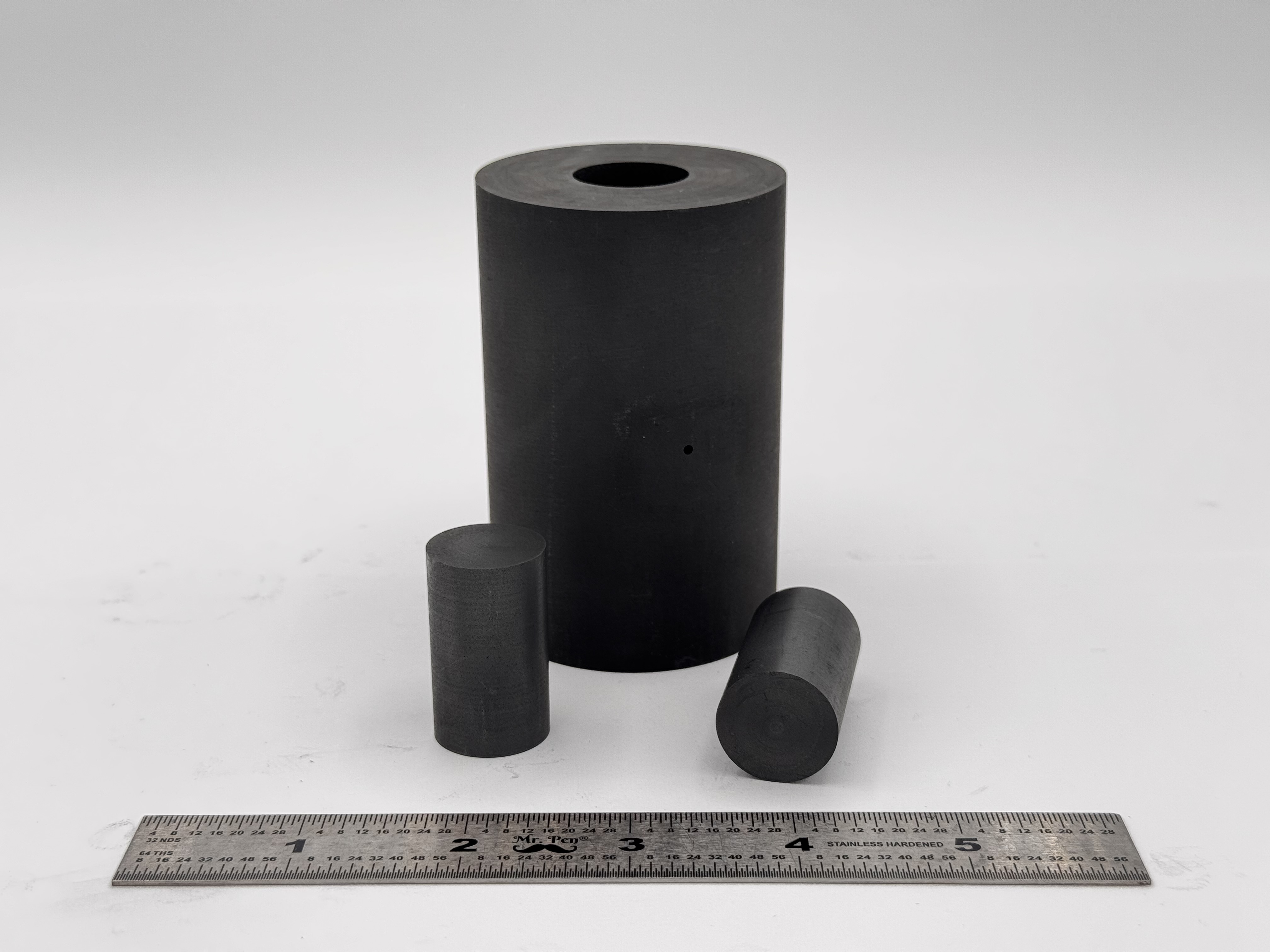
 High Strength SPS Graphite Tooling
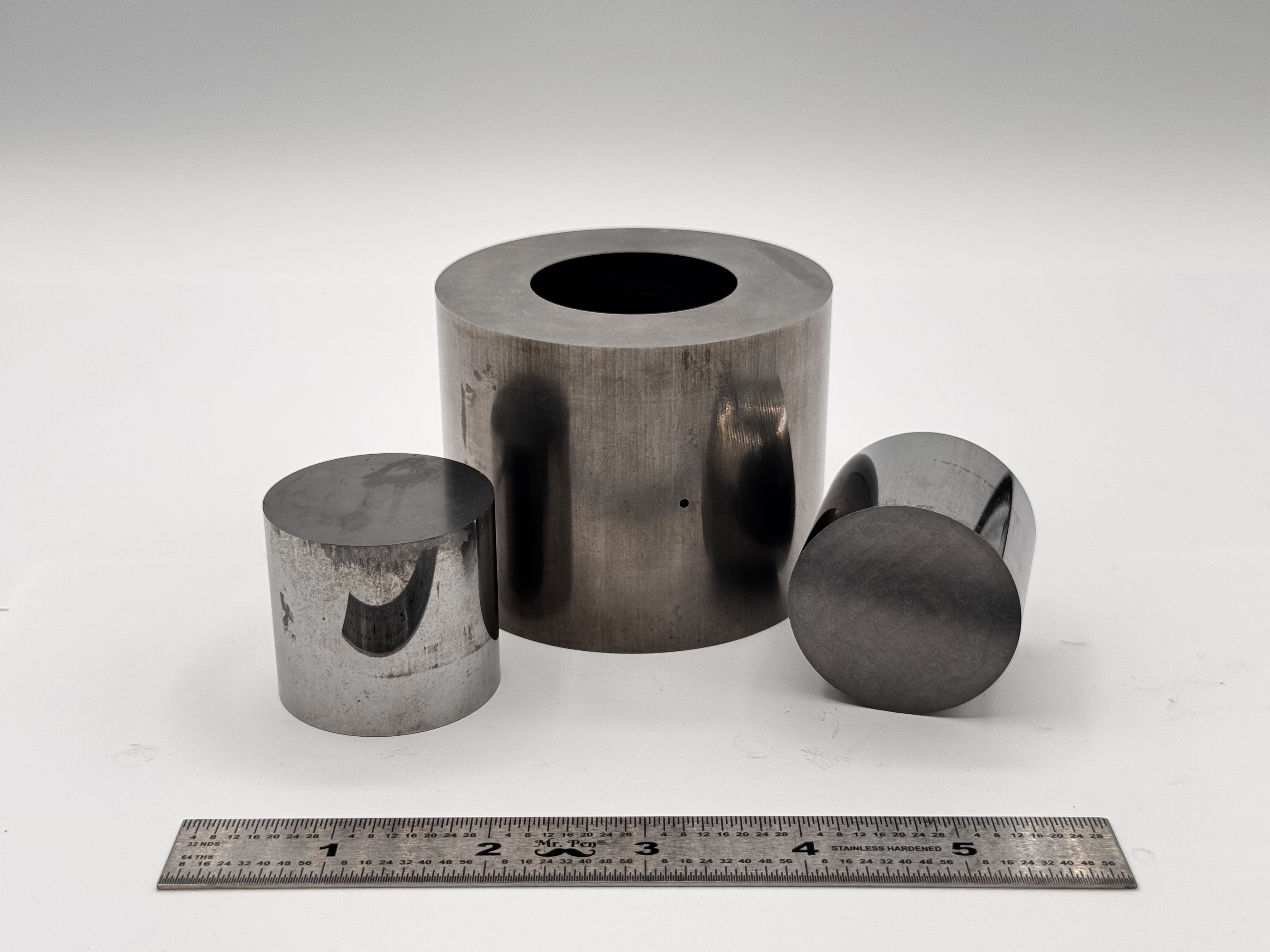 Tungsten Carbide Tooling
 Carbon Graphite Foil / Paper
 Carbon Felt and Yarn
 Spark Plasma Sintering Systems
 SPS/FAST Modeling Software
From Lab to Tons per Year: Scaling Spark Plasma Sintering for Reactor Components
Spark Plasma Sintering (SPS), also known as Field-Assisted Sintering Technology (FAST), is one of the most advanced and versatile powder consolidation methods available today. By combining pressure with pulsed electrical current, SPS rapidly densifies powders into fully dense parts while maintaining tight control over microstructure.
Traditionally, SPS has been used in laboratory settings for research and prototype development. Today, however, it is evolving into a scalable and repeatable manufacturing process suitable for industrial production.
This shift is especially important for reactor components, where performance requirements are extremely high and failure is not acceptable. At California Nanotechnologies, scaling SPS from small lab quantities to full production volumes is an active engineering effort focused on pushing the limits of advanced manufacturing.
The Promise of SPS for Reactor Applications
Reactor environments—whether nuclear, fusion, or high-temperature energy systems—place extreme demands on materials. Components must withstand high temperatures, thermal cycling, corrosion, radiation exposure, and mechanical stress.
SPS provides a strong alternative to traditional manufacturing methods. Its rapid heating rates allow for densification at lower temperatures and shorter cycle times, helping preserve key material properties like strength, toughness, and creep resistance.
SPS also enables the processing of difficult materials such as refractory metals, advanced ceramics, and composites. These may include tungsten, molybdenum alloys, silicon carbide, and oxide dispersion-strengthened materials.
For reactor components, this can lead to:
- Improved mechanical performance in extreme environments
- Better thermal performance (conductivity or insulation)
- Increased resistance to radiation damage
- Custom microstructures tailored to specific applications
While these benefits are proven in the lab, achieving them consistently at production scale introduces new challenges.
The Challenge of Scaling SPS
Scaling SPS is not simply about using larger equipment. It requires rethinking the entire process to ensure consistency, reliability, and cost-effectiveness at higher volumes.
Equipment and System Design
Lab systems are built for flexibility. Industrial systems must deliver repeatability and high throughput.
Key considerations include:
- Higher press forces for larger parts
- Power systems capable of delivering and controlling higher currents
- Advanced thermal management to control temperature gradients
- Automation for loading, monitoring, and data collection
Uniformity in Larger Components
Maintaining uniform temperature and pressure becomes more difficult as part size increases. Variations can lead to:
- Density differences
- Residual stress
- Microstructural inconsistencies
- Reduced performance
To address this, engineers rely on simulation, improved tooling design, and real-time monitoring systems.
Throughput and Production Efficiency
In production environments, speed and efficiency are critical. Scaling SPS requires:
- Faster cycle times without sacrificing quality
- Reduced downtime
- Optimized heating and cooling
- Multi-part processing strategies
The goal is to increase output while maintaining consistency.
Tooling Durability and Lifecycle
Graphite tooling is commonly used in SPS, but it wears over time due to heat and stress.
To improve durability and reduce costs, solutions include:
- Stronger graphite materials
- Protective coatings
- Hybrid tooling designs
- Optimized geometries
Quality Assurance and Certification
Reactor components must meet strict standards. Scaling SPS requires robust quality systems, including:
- Process validation
- In-process monitoring
- Full traceability
- Non-destructive testing
- Mechanical and microstructural verification
Engineering Solutions for Industrialization
California Nanotechnologies approaches SPS scale-up as a complete engineering system rather than a single process.
Advanced Modeling and Simulation
Simulation helps predict temperature, electrical flow, and stress during processing. This reduces trial-and-error and speeds up development.
Custom Equipment Design
Standard SPS machines are often not sufficient for production. Custom systems are designed to provide:
- Higher force and power
- Better uniformity
- Increased reliability
- Integration with automation
Real-Time Monitoring and Control
Sensors and control systems allow continuous monitoring of key variables, enabling:
- Immediate issue detection
- Adaptive process control
- Data collection for traceability and improvement
Scalable Tooling Solutions
Tooling is optimized for both performance and durability, including:
- Modular designs
- Improved materials and coatings
- Multi-part capable configurations
Collaborative Development
Scaling SPS often requires close collaboration between engineers, designers, and customers to meet both technical and production requirements.
From Innovation to Production Reality
Spark Plasma Sintering (SPS) is transitioning from a lab-based process to a true manufacturing platform. For reactor components, this opens the door to higher performance, improved reliability, and new design possibilities.
By solving challenges related to equipment, uniformity, throughput, tooling, and quality, SPS is becoming a scalable solution for advanced materials production.
California Nanotechnologies is helping lead this transition—bridging the gap between research and real-world manufacturing.
As demand for high-performance materials continues to grow, SPS is positioned to play a key role—not just in making better materials, but in transforming how they are produced.